Thursday, 7 January 2016

The deforesting Chinese land

The Chinese are cutting down the trees.  Deforestation has always been the opportunity cost of economic growth.  The demand for wood are from economic activities such as furniture-exporting and agriculture.  I'm going to focus on the impact of agriculture, on how croplands increase local temperature.

He et al. (2015) talks about how deforestation change the potential energy budget in China, namely the Northeast part.  Deforestation and land use change cause more than 10% of GHG emission (theguardian).   Over the past 300 years, 9.2% of forested area in China has disappeared.  The major cause of this is the conversion to cropland.  

In the article they uses satellite observation to investigate the impact of climate of land use change.  This would have less variation from difference model structures and parameters and would generate more constant result compare to climate models.  The study focuses in Northeastern China which is a main agricultural region and accounts for 20% of China's total cultivated area.

              
The conversion from forest to cropland not necessarily will heat up the surface.  Land surface albedo will increase (as seen in the graph) and will affect the shortwave radiation budget.  Short vegetation such as crops have a brighter surface and negative shortwave radiative forcing*, and will lead to local cooling.
*radiative forcing refers to "change in net radiative flux caused by an imposing change such as increase in CO2 or change in albedo" (He et al, 2015).

However land surface temperature (LST) increases when we includes some other factors.  For example, larger latent heat fluxes together with evapotranspiration will reduce LST in forests.  The average nighttime LST between crops and forest can be up to -2.30K*, which leads to forest area daily average temperature are cooler than croplands.
*K is a unit for LST


This graph shows how China's temperature increases from 1873-2008, which shares a similar pattern with the global temperature.  How is the impact of climate change treating China?  By 2030, the growing capacity of China's crop will reduce by 10%, including rice, wheat and corn.  There will be reduction in water resources in the major rivers and will increase disease attack and associated propagation. (Qin et al, 2010)


China is trying to address the issue by engaging in a massive tree-planting program in the North.  It is going to cover 2,800 miles across the Northern part of China.  According to the State Forestry Administration China has planted 32 million acres of new forest since 2008 (Quartz).   Can the afforestation in the future compensation the deforestation in the past decades?

Tuesday, 5 January 2016

The economics of leadership: Has EU failed in leading the world to fight climate change

As the impact of COP21 is yet to be seen, with regards to previous agreements and actions, the ineffectiveness of how the World fights climate change is undeniable.  In this blog I am examining whether the Western countries namely the European Union, has failed to lead the rest of the World to effectively engage in climate change mitigation measures. 

The word leadership is defined as 'asymmetrical relationship of influence in which one actor guides or directs the behaviour of other towards a certain goal' (Underdal, 1994).  There are few types of leadership such as structural leadership and directional leadership.  With regards to climate change, other forms of leadership apart from directional leadership is not viable.  For example, structural leadership requires coercion yet political powers will not impose mitigation goals upon each other which narrows our focus on directional leadership.

Directional leadership works leaders lead followers through example.  According to Dannenber (2014), leading by words is much more ineffective in stimulating cooperation between leaders and followers when compare to leading by example.  With reference to climate change mitigation, it is the failure of Kyoto Protocol.  The world's greenhouse gases emission has increased by 58% than 1990 despite the target was to cut the emission by 5% (CBC).  


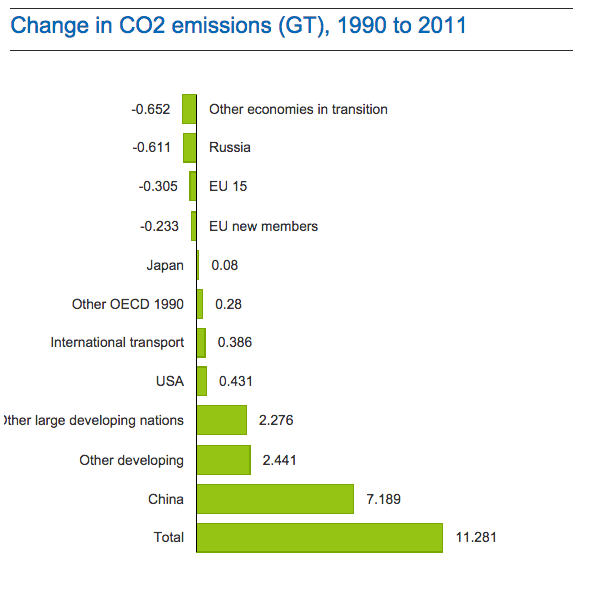
What are the flaws?  The intention of Kyoto Protocol is good, for sure.  For bringing the world together in order to fight against climate change.  However under directional leadership, the leader will need to have sufficient sacrifice in order to motivate second-mover to make contribution (Gergor Schwerhoff, 2015).  From the above chart if convert to percentage, the EU has only managed to reduce emissions by roughly 1% while the developing world has contributed 7% increases in CO2 emission.  The data will only go worse when we exclude the effect of EU ETS, of which some countries such as Italy did not reduce its emission at all.  Moreover, as I mentioned in my last blog, much of the China's CO2 emission is generated during the production of goods exporting to the Western World.  The sacrifice from the leader is insignificant.  


The EEA may say they are on track on meeting the 20% reduction target set in 2007.  However, some scholars have been criticising EU's leadership.  Parker et al. (2012) claims according to the surveys at COP 14 and 15, 'large number of followers did not embrace the EU's negotiation goals'.  Backstrand and Elgstrom (2013) also claiming that the EU's action is not sufficiently ambitious, which could be seen from the low carbon price (opportunity cost) at the EU ETS and the slow decline in aggregate CO2 emission.

One of the argument in Schwerhoff's paper is genuine sacrifice has to be seen by the followers given by the leaders.  Especially when motivating second-movers to contribute in climate change mitigation, of which he regarded as a public good which can be easily being free-ride.  More investment in energy efficient and renewable energy are needed for the rest of the World (followers) to make significant follow-up contribution.
 

Saturday, 2 January 2016

When clean air no longer is a free good: The economics of air pollution

The cause of heavy smog in Beijing is similar to the great smog in London in 1952:  Immense consumption of coal.  In the winter of 1952, they heavy burning of coal in the Londoners' home, together with the anticyclone which prevent the smoke rose into the atmosphere, caused the great smog in 1952.  Similarly, Beijing has been suffering from smog in recently years.  The heavy reliant of China's economy on steel means huge amount of coal has to burnt in order to produce steel.  Burning coal release air pollutants named PM 2.5 (particulates smaller than 2.5 micrometer) into the atmosphere.


How much more coal is China burning in 2010 than UK's 1952 record?

According to UK's Department of Energy & Climate Change, the coal consumption in 1952 is 225 million tonnes, which have already caused the great smog.  Meanwhile in China, solely in 2010 the total amount of coal burnt is 3.2 billion tonnes.  This is 13 times of the 1952 UK's level.

Consequently, air pollution is severe in China.  It is best shown in its capital city, Beijing.  Beijing issued its most severe air pollution warming in December 2015.  The level of PM 2.5 in the air is 20 times more than the World Health Organization suggested level.


The pie chart above shows where does the air pollutants came from.  Beijing has the worst air pollution compared to other more industrialised cities is because of the huge rise in car ownership (approximately 5 millions vehicles, Yahoo), which accounts for 22% of the PM 2.5.  Direct coal pollution itself contributes 16.7%, while the "pollution from districts around Beijing", for example Hebei province, involves high amount of coal burning from steel production and coal-fired power plants (11% of world's production of steel;  95% of public heating from coal; Fortune), the effect of coal pollution is huge.

As a result of air pollution and smog, clean air has changed from free, public goods into luxury goods.

Affluent Chinese starting to buy bottle of fresh air from Banff National Park in Canada for roughly £10/bottle and is 50 times more expensive than a bottle of mineral water.  The most interesting part is that the founder of the company, Vitality Air starts the company as a joke but ending up created a huge market of clean air.


What is the economic cost of smog?

  1. According to the World Bank, disease and death caused by air pollution leads to annual losses of 3% of GDP in the 21st century
  2. Lower life expectancy.  People in Northern China has 5 year less life expectancy than people in the South and caused 1.6 million people died prematurely annually. (theguardian)
  3. Agricultural loss.  The paper written by Wei et al. (2014) indicates the relationship between air pollution and economic agricultural loss.  The economic growth of major Chinese cities rely on the burning of fossil fuels and emits pollutants such as PM10 and SO2.   While according to Cao (1989), high concentrations of SO2 for some Chinese cities and industrial areas in the 1980s reduce the growth and yield of local crops and vegetables by 5.25%.  Wei examined this statement using empirical data.  They have created an equation estimating agricultural economic loss including variables such as crop production under influence of SO2.  They concluded that solely in 2008 the loss due to SO2 are roughly 1425m USD$ (0.66% of agricultural value of China).  They also found significant positive correlation in regional agricultural loss and industrial emission.

To me, the causation of smog in Beijing is not solely the consequences of the Chinese over-polluting their homeland in exchange of economic development.  It is also the result of global economic development.  Many of the Western countries still enjoying economic growth is because they have outsourced the production process to the East, especially China, where labour cost is low.  Yes, the Chinese is polluting their atmosphere in order to produce goods for more GDP.  Yet how much of these will end up selling in Europe?  How many of the goods nowadays are made in China?  Can we exempt ourselves from the pollution in Beijing?