The word leadership is defined as 'asymmetrical relationship of influence in which one actor guides or directs the behaviour of other towards a certain goal' (Underdal, 1994). There are few types of leadership such as structural leadership and directional leadership. With regards to climate change, other forms of leadership apart from directional leadership is not viable. For example, structural leadership requires coercion yet political powers will not impose mitigation goals upon each other which narrows our focus on directional leadership.
Directional leadership works leaders lead followers through example. According to Dannenber (2014), leading by words is much more ineffective in stimulating cooperation between leaders and followers when compare to leading by example. With reference to climate change mitigation, it is the failure of Kyoto Protocol. The world's greenhouse gases emission has increased by 58% than 1990 despite the target was to cut the emission by 5% (CBC).
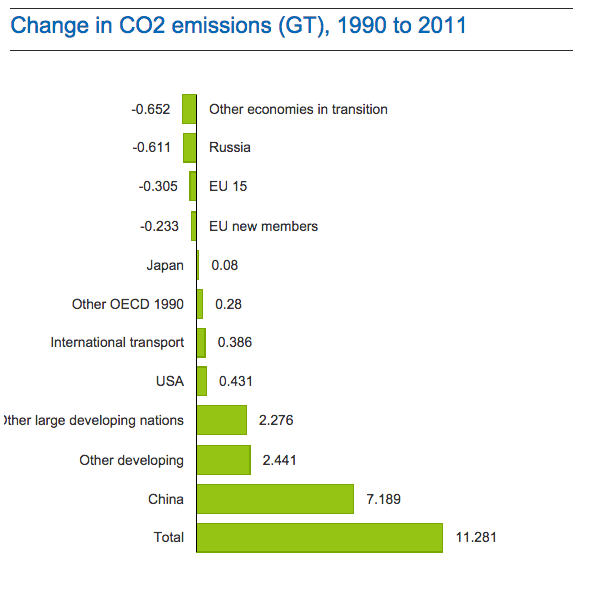
What are the flaws? The intention of Kyoto Protocol is good, for sure. For bringing the world together in order to fight against climate change. However under directional leadership, the leader will need to have sufficient sacrifice in order to motivate second-mover to make contribution (Gergor Schwerhoff, 2015). From the above chart if convert to percentage, the EU has only managed to reduce emissions by roughly 1% while the developing world has contributed 7% increases in CO2 emission. The data will only go worse when we exclude the effect of EU ETS, of which some countries such as Italy did not reduce its emission at all. Moreover, as I mentioned in my last blog, much of the China's CO2 emission is generated during the production of goods exporting to the Western World. The sacrifice from the leader is insignificant.

One of the argument in Schwerhoff's paper is genuine sacrifice has to be seen by the followers given by the leaders. Especially when motivating second-movers to contribute in climate change mitigation, of which he regarded as a public good which can be easily being free-ride. More investment in energy efficient and renewable energy are needed for the rest of the World (followers) to make significant follow-up contribution.

No comments:
Post a Comment